ANGLORIGINAL™
ANGLORIGINAL™
Jesus, Dogs and Alcohol
The Angloriginal culture has many elements within it. Some are undemanding but deeply grounding religious beliefs and traditions. Some are superlative civilised standards founded in the evolution of a collective empathy. Others are simply social attachments that assist in our human to human interactions at the daily level.
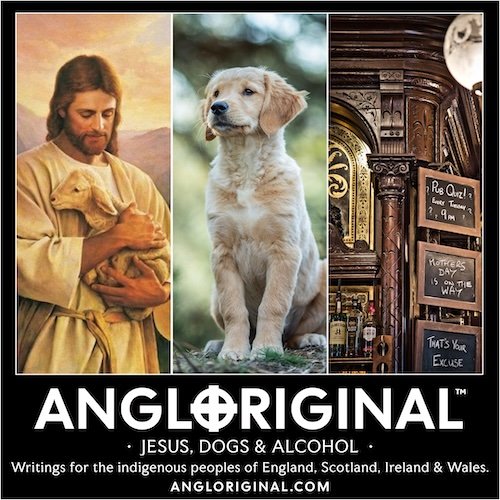
To my mind, “Jesus, dogs and alcohol” wraps up in three simple words this conundrum of seemingly disparate but provenly harmonious cultural norms, which perfectly epitomise the superlative cultural standards of the Angloriginal peoples, representing social morality, universal compassion & communal ingenuity.
JESUS
It is fair to say that the indigenous peoples of England, Ireland, Scotland and Wales have been more at the very centre of Christian evolution over the last 2000 years than any other native group of nations.
It begins with the story of Jesus visiting Glastonbury with his uncle, Joseph of Arimathea, where the seeds of Christianity were first planted in Britain, centuries before the Catholic church was even conceived.
Then there is the marriage of Jesus to Mary Magdalene at Glastonbury Tor, as outlined in the Gospel of Phillip, which was one of the gospels forbidden for inclusion in the Bible by its Roman and Jewish editors. This hidden history was later re-ignited by the Knights Templar, who claimed that they had discovered evidence of Mary’s time in Britain.
Then came the founding saints of the Anglo Isles – St. George in England, St. Patrick in Ireland, St. Andrew in Scotland, and St. David in Wales. Each has not only had a monumental cultural and historical impact on Britain, but also on the entire Anglosphere and on Christianity as a whole. Their teachings on the civilising messages of Jesus to the indigenous peoples of the Anglo Isles, created the foundations of Angloriginal morality, fairness and individual sovereignty, which have defined Angloriginal society and politics throughout the last 1500 years – from King Alfred to the likes of William Wilberforce, and beyond.
The Angloriginal peoples have always been very singular in their Christian beliefs, forming their own distinct ideas as Catholics, Protestants, Methodists, Baptists, Evangelicals, and various other denominations that have since expanded throughout the world.
Above all, within this rich tapestry that is the Christian faith, the indigenous peoples of England, Ireland, Scotland and Wales have repeatedly sewn into that cloth a golden thread – the moral and compassionate teachings of Jesus. To those who truly understand Christianity, it is those teachings that are the authentic and superlative message of the Bible.
They have always remained at the very heart of Angloriginal Christianity, and at the heart of Angloriginal culture and Angloriginal values. Regardless of whether an Angloriginal was religious or secular in their beliefs, they would still be educated with the moral values that had been taught by Jesus, and other great teachers throughout history who have been followers of ‘the path’.
Within Angloriginal culture, Christianity requires that the best among us strive to follow in the footsteps of Jesus, by promoting truth, fairness, forgiveness, peace, and universal compassion to all those within Angloriginal society who are prepared to listen and learn.
The culture does not require obedience to the religion or an observance to it. It merely demands that the moral teachings – which have been proven universally to exactly parallel what it means to be civilised within society – will remain inextricably bonded into the Angloriginal culture, guiding the laws and customs of the Angloriginal nations.
DOGS
The Angloriginal people love dogs, just as much as dogs love their Angloriginal companions. Angloriginals don’t simply see their dog as a pet. 99% of dog owners within the Anglo Isles see him or her as an equal member of the family, and almost a third of all households have at least one dog. [see The 2024 National Dog Survey.]
One misconception about Angloriginal dog owners is that everyone wants a particular breed. In fact, the same survey showed that “42% of dogs were crossbreeds, with ‘supermutts’ – a completely unknown mix of breeds – taking the lead at almost 10%.” Furthermore, the top three pure breeds were all what you might call ‘Angloriginal dogs’ – Labrador Retrievers at number one (8% of all Angloriginal dogs), Cocker Spaniels at number two, and Border Collies at number three, holding the same positions as previous surveys.
There is something about the connection between people and dogs that is divine in nature.
The great spiritual philosopher Alan Watts once said, “Dogs are a representation of God’s presence on earth.” What he meant by this is that the way in which a dog shows unconditional love for their human companion is the same way in which the true God – the Universal All – exhibits unconditional and eternal love for not just people, but for all life. When a person connects with a dog in this empathic way, they are experiencing that universal love of the divine. Indeed, perhaps one can tell a person’s proximity to God by their capacity to connect with dogs.
Yes, of course, there is a clear hypocrisy in the way in which a “nation of animal lovers” can go gooey over seeing a baby lamb one minute and then consume one from their plate the next, but that failure to be consistent is all part of the messy process of social development.
After all, prior to the orchestrated destruction of Angloriginal principles that we have all witnessed since the beginning of this century, the Anglo Isles were leading the world in the discussion on such topics. Such inconsistencies in how people regard the life of a lamb is only notable because the Angloriginal culture demanded that such hot topics must be openly discussed in the public space.
Whichever side of the argument you are on, true Angloriginals will all look back with fondness to those times when you could publicly and openly argue for whatever you believed in, without fear of arrest. Sadly, over the last 25 years, such core indigenous standards as free speech have been systematically targeted for destruction by the fifth columnists.
The bottom line is that we cannot discount the clear global lead in compassion towards animals that the Angloriginal mono culture had attained by the end of the 20th century, compared to other cultures around the world. Since then, the sudden and unprecedented addition of 10 million people without the same universally compassionate cultural standards has severely damaged those previous social advancements.
However, with a clear determination towards re-establishing Angloriginal values, and perhaps with a little help from our canine friends, we can revive and restore the compassionate leadership in the world that the Angloriginal people had attained just a generation ago.
ALCOHOL
A true analysis of the Angloriginal peoples is never complete without a good understanding of their relationship with alcohol, and most notably: whisky, gin, beer, and of course, the world’s superlative drinking and meeting establishment, the Angloriginal pub.
Whisky
Both Irish and Scottish cultures are indelibly linked to whisky distilling, whisky drinking, and all the pastimes and leisure activities that may have been a direct result of such consumption. Scottish whisky distillation can be dated back to 1494, whereas Irish whiskey distillation is documented to 1405, but may go back as far as the 12th century. In both countries, indigenous Christian monks can be thanked for the creation of this central element of Angloriginal cultural heritage.
It is reasonable to suggest that a game like golf may have only been invented due to the Scots drinking whiskey. The first documented mention of golf is in 1457, exactly half way between when the Irish officially began distilling and when the Scottish started, so we can assume that the Scottish had just started drinking imported Irish whiskey regularly at this exact same time.
Another reasonable assumption to make is that Irish whiskey culture may well have been responsible for the indigenous Irish people’s love of playing music and their talent for poetic prose. A long history of socialising in pubs, and the amount of famous Irish musicians and writers who are known for their love of whiskey may indicate a strong likelihood that this is indeed the case.
Irish whiskey and Scottish whisky are core indigenous creations of the Angloriginal peoples, and should be legally protected as such. All distilleries should be at least majority indigenous owned, managed and controlled.
Gin
Although gin was originally invented in Italy in the 12th century, it evolved from its medicinal roots in England in the 17th century, to become the Angloriginal spirit known and loved today throughout the world. These huge advancements in gin production only occurred because the British government decided to restrict French brandy imports and support domestic gin production. Today, this would be seen negatively as a ‘trade war’ or ‘protectionism’. Back then, it was understood to be a very socially positive action that put indigenous businesses first, and provided greater economic security to the nation as a whole.
In the 18th century, foreign commercial interests began to weaponise gin drinking within the London population, maximising profits by diminishing the quality and purity of the gin, with an aim to monopolise the trade. This led to a high crime wave and many alcohol related deaths and abuses. This in turn led to the Gin Act of 1751, which imposed high fees for retail licenses, thereby limiting the number of small operators in the industry.
However, when properly re-examining the whole affair with an open and discerning mind, the entire operation was clearly orchestrated, and even promoted in the 18th century version of the media, by cartoonists such as William Hogarth. The ruse is a carbon copy of the same tactics used by transnational corporations today, which control parliament, the media, and public perception, in order to cripple small businesses and take over control of entire indigenous industries.
A return to government supported indigenous craft gin distilleries, which operate in traditional ways, in order to produce the highest quality and purest gin, is something that any future Angloriginal allied government must seek to implement.
Beer
Beer was first brewed in England and around the Anglo Isles by Celtic tribes well over 2000 years ago. In the Middle Ages, the Angloriginal monasteries played a significant role in the organised production of beer, but the real change that placed England at the very centre of the global beer story came in the 14th century, when hops was first introduced to England from Northern France, allowing the beer to be preserved for longer, and helping to produce the wide variety of tastes found in modern beer. Homegrown hops were introduced in the 1520s.
By the 1880s, there were over 10,000 large breweries in Britain. Compare that to a century later when there were a mere 500. Once again, the destructive forces of transnational corporations and their aligned globalist free trade model were at play.
Bought-and-paid-for politicians protected, promoted and subsidised multinationals, whilst at the same time demonising and penalising small businesses, resulting in the loss of not only the livelihoods of indigenous peoples, but also the loss of national security. It was a blatant destruction of the self-sufficient local and regional trading infrastructures that had previously been in place, and which had provided everything from food security to basic maintenance of public services and energy security.
Over the last 150 years, this alliance of corporate thieves and fifth columnist politicians has systematically stolen away the ownership, control and management of those thousands of indigenous breweries and supporting businesses, and handed them over to a handful of faceless multinationals, which are all owned by members of the same non-indigenous parasitic class of billionaires and trillionaires.
The Angloriginal beer industry – as well as all other core food and service industries – must once again become owned and controlled by indigenous companies, which primarily deal with indigenous manufacturers, service suppliers, and logistics companies.
Such indigenous owners will always tend towards placing the quality of their product, the job security of their staff, and the national security of their country above excessive profits, which non-indigenous owners have been proven unequivocally not to do. They follow the money rather than the rules.
Again, these indigenous companies must be subsidised by government, whilst the transnational companies must be equally penalised, simply in order to reverse over 100 years of organised industrial theft.
The Great Angloriginal Pub
There is no greater emblem of social drinking than the Angloriginal pub. Show anyone in the world a picture of a traditional country pub in Devon, Dublin, Dunfermline or Dolgellau, and you will get a smile in return.
If you want to know whether any government or council within the Anglo Isles represents indigenous peoples, or alternatively, foreign interests, you simply need to look at their policies towards pubs.
In both village life and city life, the pub has always been at the heart of the Angloriginal community. When the pub dies, the local community dies with it.
Pubs have also always been where people meet to openly and honestly discuss the issues of the day. They are the one place where people will actually forget that they have a Smart Phone. Instead, people openly converse with one another and put the world to rights. Authoritarian states don’t like that sort of communication. They want everyone to communicate online, where everything can be monitored and recorded.
Those who wished to end such daily, private banter between individuals, and destroy traditional communities within England, Ireland, Scotland and Wales, knew that in order to do so they needed to destroy pub culture, and close down the tens of thousands of small, independently owned pubs throughout the Anglo Isles. That is exactly what you have been witnessing over the last 25 years. The agenda could’t be more obvious.
An Angloriginal-aligned government must heavily subsidise the existing pub trade as a priority, and particularly support the freeholder and the village pub landlord.
Financial support must be made available for the re-opening of at least one traditional pub in every hamlet, village and town throughout the Anglo Isles.
Local pubs must be re-opened in order to reconnect local communities, and Anglorigional pub culture must be given a new lease of life, as hubs of the community that focus on traditional, locally brewed beer and distilled spirits, and on locally produced food, and locally owned services.
Empowering the Native Indigenous Peoples of the Anglo Isles
So remember, if anyone should ever dare to claim that you have no right to shout from the rooftops about your own most glorious Angloriginal culture, values, and heritage, you know what to say to them,
“Jesus, Dogs, and Alcohol!”

Member subscribers can comment on this and all other posts at Angloriginal™ on Substack.
Posts are published on Substack around 48 hours after being published on angloriginal.com.
[Note: You need to be signed in to Substack to view the 'Member subscribers' link sign-up options page.]